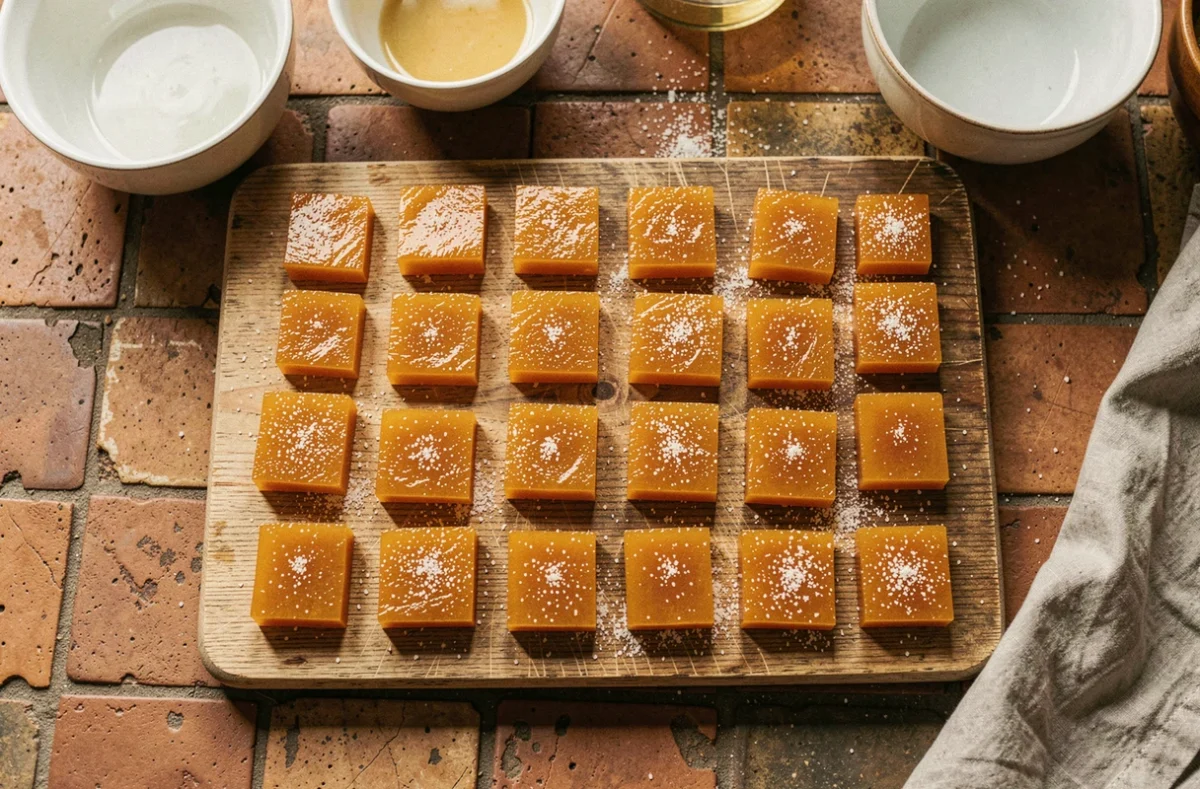
Dried quince paste can yield a firm and translucent result, or remain desperately soft and sticky. The difference between these two outcomes is less about the recipe itself and more about the drying parameters: actual temperature in the chamber, air circulation, thickness of the cut, and control of residual humidity. Understanding what happens during these hours of slow drying helps avoid the most common failures.
Displayed temperature and actual oven temperature: the gap that changes everything
The first factor of failure has nothing to do with the recipe. The setting displayed by the oven is not necessarily its actual temperature, especially in the low range used for drying. Domestic ovens are designed to cook between 150 and 250 °C. Below that, regulation becomes approximate: the thermostat can cause heat spikes followed by sharp drops.
An independent oven thermometer, placed next to the drying tray, often reveals a notable discrepancy between the set temperature and reality. This discrepancy explains why a paste dries too quickly on the surface (dry crust, soft center) or does not dry at all despite hours in the oven.
| Parameter | Successful drying | Failed drying (soft or crusty paste) |
|---|---|---|
| Actual temperature | Low and stable, verified with a thermometer | Variable, often higher than displayed |
| Air circulation | Door ajar or convection heat | Closed oven, trapped humidity |
| Thickness of the paste | Even across the surface | Uneven (thin edges, thick center) |
| Post-drying control | Resting overnight on a rack | Immediate hot packaging |
This table summarizes the gaps that separate controlled drying from a disappointing result. Each line corresponds to a concrete lever to act upon.
To better understand the step-by-step protocol, several guides detail how to dry quince paste in the oven with the right settings and equipment.
Air circulation and evaporation: the role of oven ventilation
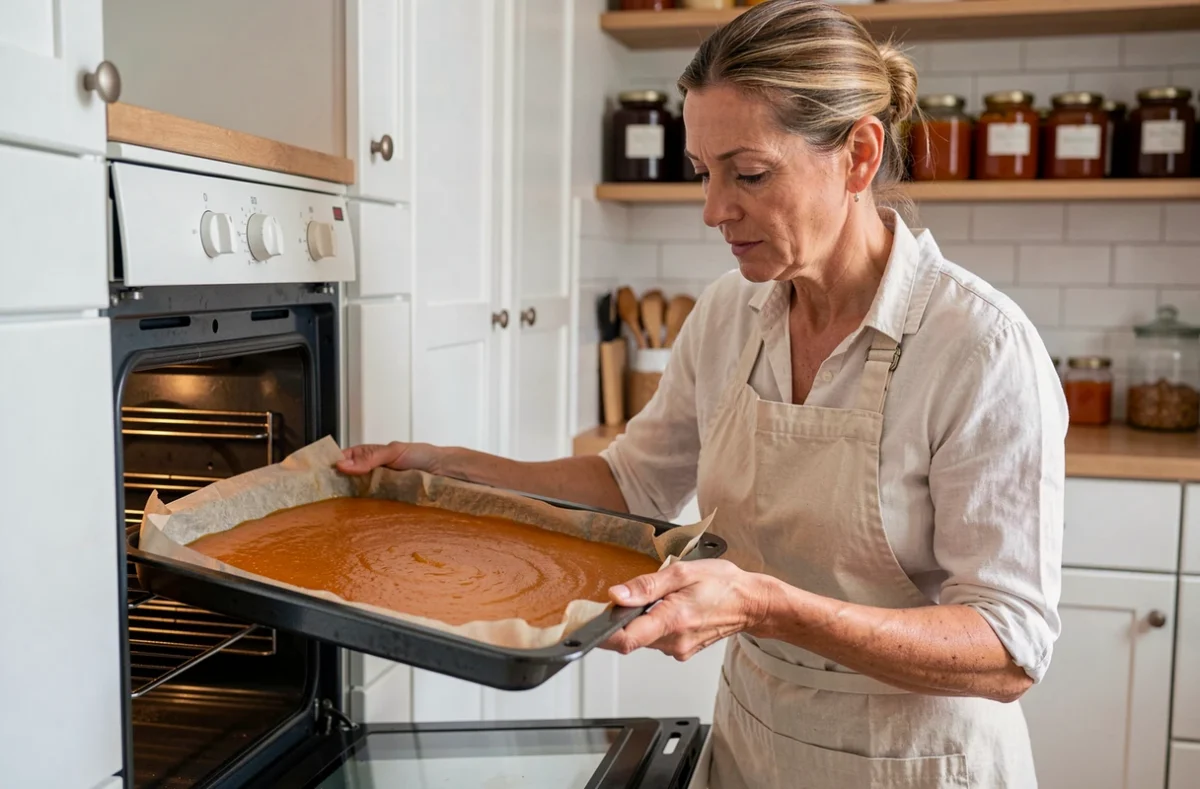
Air must circulate as much as heat must be gentle. Drying relies on the gradual evaporation of water contained in the quince marmalade. If this steam remains trapped in the chamber, it saturates the oven atmosphere and slows the process. The paste remains soft, sometimes even after several hours.
Two solutions exist to evacuate this humidity:
- Partially open the oven door using a wooden spoon wedged in the gap. Humid air escapes, dry air enters, and evaporation continues steadily.
- Use convection heat if the oven has it. The internal fan distributes heat and pushes steam towards the ventilation outlet. Drying becomes more uniform without door manipulation.
- Combine both approaches on ovens that allow it, which yields the most homogeneous results.
Without ventilation, humidity accumulates and creates a steaming cooking environment. The result: a paste that shines on the surface, slightly oozes, and never achieves that firm and slightly elastic texture characteristic of well-dried quince paste.
Cut thickness and uniformity: the trap of uneven paste
Even before turning on the oven, the cutting of the paste determines part of the result. An irregular thickness causes a two-speed drying: thin edges become brittle while the center remains soft.
Spreading the quince marmalade in an even layer across the entire tray is the most underestimated gesture of the process. Using a bent spatula or the back of a spoon helps smooth the surface. The ideal thickness depends on the oven and available time, but uniformity matters more than absolute fineness.
Parchment paper placed on the tray also plays a role. It prevents the paste from sticking, but more importantly, it facilitates flipping halfway through drying. Flipping the paste halfway exposes the underside to air and accelerates the evaporation of trapped moisture against the surface.
How to check if the center is dry
Touch alone does not guarantee that the center of the paste has lost enough water. A non-sticky surface can mask moisture in the middle. The most reliable test is to take the paste out of the oven, place it on a rack, and let it rest for a full night at room temperature.
The next day, observe each piece. No area should become shiny or oozy after this rest. If it does, an additional stint in the oven is necessary, always at low temperature and with the door ajar.
Cooling and packaging: the mistakes that ruin drying
The drying is complete, the paste looks perfect. Storing the pieces in an airtight box immediately is the last mistake to avoid. Packaging the still-warm paste causes condensation in the container, and this moisture gradually softens what had been patiently dried.
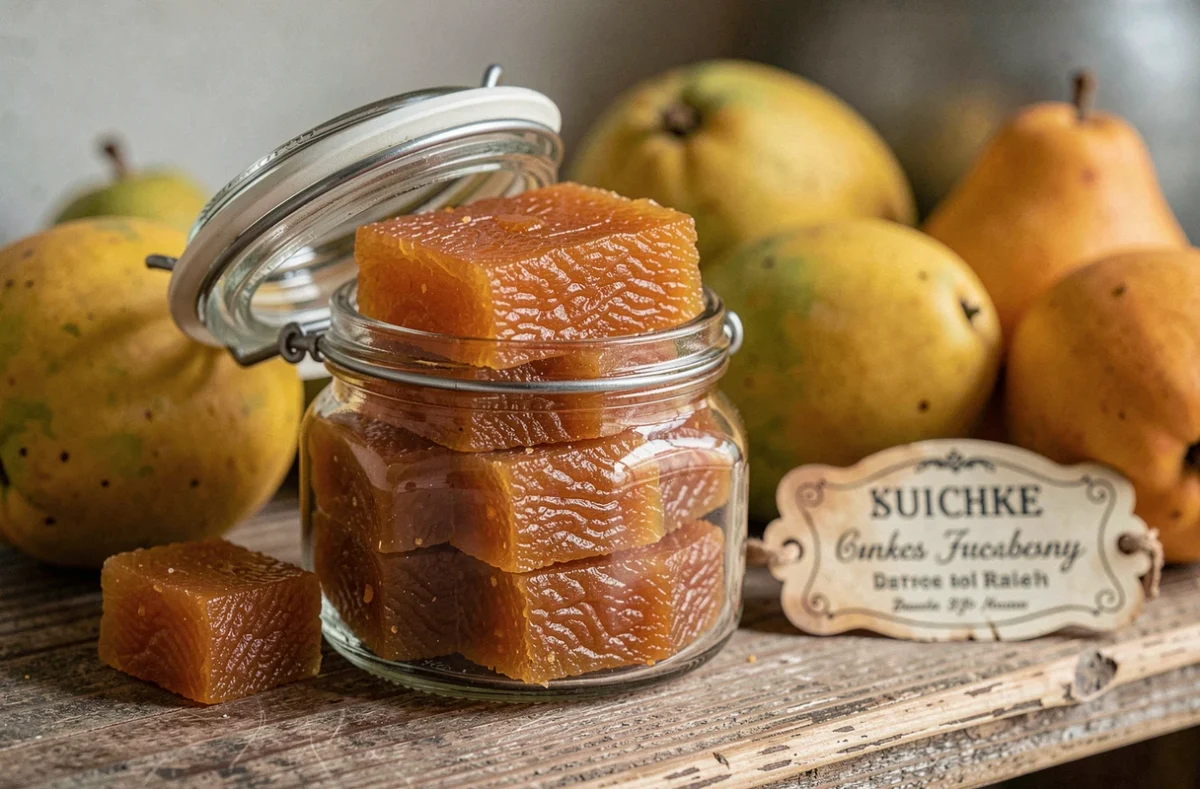
The paste must cool completely on a rack, in the open air, before any packaging. This cooling can take several hours. Once the paste is perfectly cool and matte to the touch, placing it between sheets of parchment paper in a box limits sticking between pieces.
Shelf life after oven drying
Properly dried and packaged quince paste can be stored for several weeks in a cool, dry place. The texture evolves slowly: it firms up further in the days following drying, which is normal. If it becomes sticky or shiny again, it is a sign that the residual humidity was too high at the time of packaging.
Oven drying requires little equipment but a lot of attention to invisible parameters: actual temperature, ambient humidity in the chamber, layer uniformity. An oven thermometer and a cooling rack are the two tools that make the difference between firm quince paste and a sticky failure.