
When living near the border or planning a shopping weekend in Berlin, the first surprise is that there is no official sales calendar in Germany. Since 2004, each retailer sets its own discount dates. This commercial freedom opens up opportunities throughout the year, but it also complicates planning for French shoppers used to periods defined by decree.
To find all the sales dates in Germany that are regularly updated, one can rely on specialized calendars that compile announcements from major retailers.
Price Transparency on Discounts: The 30-Day Rule That Changes the Game
Since the transposition in 2025 of a European directive, German retailers must display the price history of the last 30 days before any promotion. In practice, this means that an item marked down by 40% must prove that the crossed-out price was indeed the one practiced during the previous month.
For us, shoppers, this is a direct protection against false bargains. It quickly becomes apparent which retailers inflated their prices a few weeks before the sales to simulate a spectacular discount. The display of price history makes promotions verifiable.
This obligation also applies to e-commerce. On German websites, a small box under the discounted price must indicate the lowest price observed in the previous 30 days. If this mention is missing, it is a warning sign.
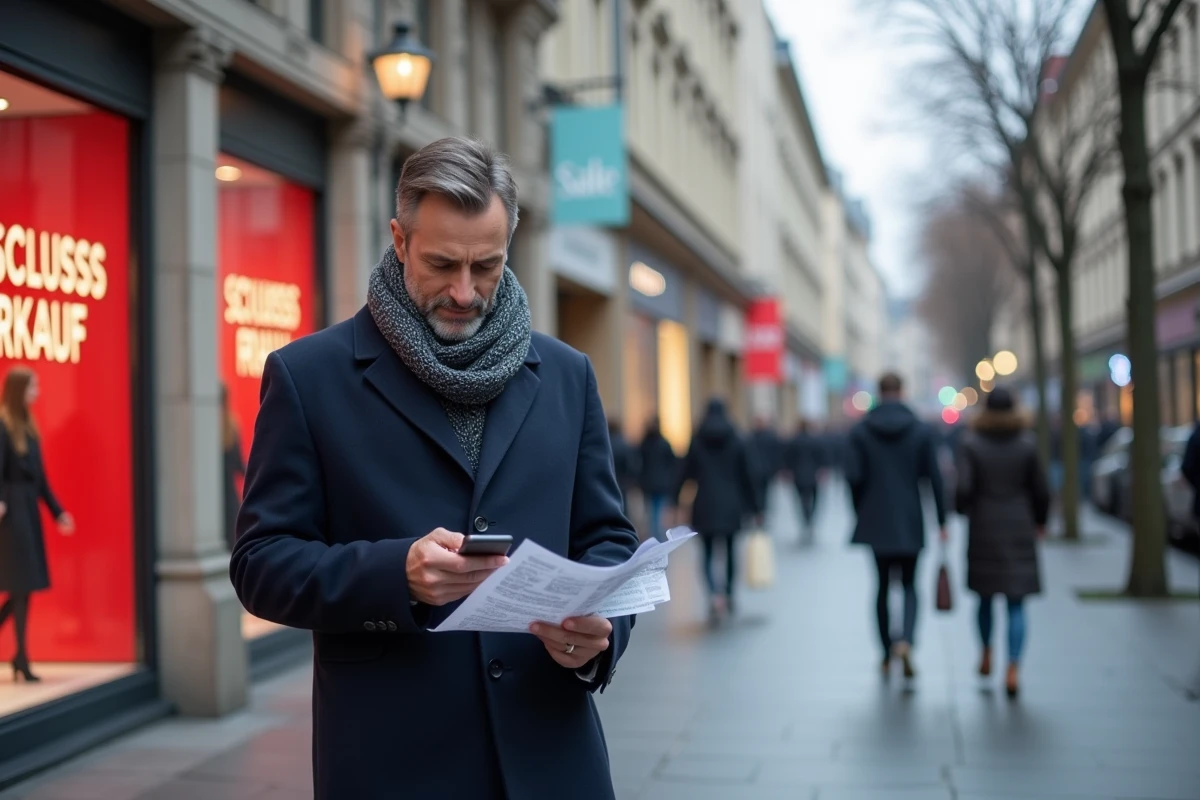
Winter Sales (Winterschlussverkauf) and Summer Sales (Sommerschlussverkauf): The Major Periods to Target
Even without a legal framework, shopping habits remain entrenched. The majority of German retailers concentrate their discounts on two key periods inherited from the old regulated system.
Winter Sales (Winterschlussverkauf)
They generally start at the end of January and stretch until mid-February. Border retailers, accustomed to the French rhythm, sometimes launch their operations as early as the beginning of January to capture customers from Alsace or Lorraine.
Summer Sales (Sommerschlussverkauf)
This period occurs between the end of July and mid-August. The summer sales in France for 2026 are scheduled from June 24 to July 21, which allows the possibility to follow up with discounts across the border immediately after.
Black Week in November
In recent years, Black Week has emerged as a third key period. Retailers in Berlin and Munich have widely adopted it to compete with the American Black Friday. Black Week tends to replace scattered autumn promotions. Discounts can be found on electronics, fashion, and home appliances, often comparable to those of seasonal sales.
Outlets and Border Areas: Where Discounts Last All Year Round
Feedback from French cross-border shoppers converges on one point: outlets like the one in Metzingen offer permanently reduced prices, with a marked intensification in January and July. A significant increase in cross-border visits was reported in early 2026, according to Les Frontaliers.lu.
Metzingen concentrates premium brands at outlet prices all year round. It features high-end fashion retailers in a shopping village setting, without the pressure of imposed dates.
For shoppers from the Grand Est, the shopping centers in Kehl, Saarbrücken, or Trier remain classic destinations. Retailers in these areas often align their promotions with the French sales calendar to attract neighboring customers.
- Metzingen (Baden-Württemberg): premium outlet, permanent discounts intensified in January and July
- Kehl and Offenburg: immediate proximity to Strasbourg, promotions aligned with French sales
- Ingolstadt Village (Bavaria): outlet near Munich, focused on international brands

Sales in Germany and Product Returns: The Flip Side of Flexibility
The total freedom on promotion dates has a rarely discussed side effect: it fuels an inflation of product returns. Without a unique sales period, German consumers frequently buy multiple sizes or colors online during promotions, intending to return what does not fit.
The right of withdrawal of 14 days applies to all online purchases in the European Union. In Germany, the culture of free returns remains deeply ingrained in shopping habits, and the multiplied promotional periods accentuate the phenomenon.
For retailers, the logistical cost of returns eats into a portion of the margins generated by sales. Some are starting to charge for returns or limit the number of free returns per customer. Returns vary significantly by category: fashion remains the most affected sector, far ahead of electronics or home decor.
For us, French shoppers, the reflex to adopt is simple: check the return policy before ordering from a German site during a promotion. Some retailers shorten return deadlines during sales or exclude discounted items from free returns.
- Check if return shipping costs are the customer’s responsibility during sales
- Read the specific conditions for discounted items (exchange possible or refund only)
- Prefer retailers that maintain free returns without restrictions as a sign of trust
Planning Sales Purchases in Germany: Concrete Reflexes
One cannot rely on a national decree. It is necessary to monitor announcements from retailers directly. The newsletters of major German chains (Zalando, About You, Breuninger) announce their promotional operations one to two weeks before the launch.
Subscribing to the newsletters of German retailers remains the most reliable way to anticipate dates. The social media of physical stores, especially on Instagram, also publish local previews.
For in-store purchases, the best deals are found at the beginning of the period on high-demand items, and at the end of sales on collection pieces or common sizes. The lowest price does not always come at the last markdown: popular items disappear quickly in a system where each retailer manages its own discounted stock.
The German system rewards organized shoppers. Without a regulatory framework, active monitoring replaces the reflex of “the first day of sales.” One benefits from comparing prices between retailers thanks to the obligation to display the last 30 days, and targeting outlets for premium brands rather than waiting for a hypothetical mega-discount online.